

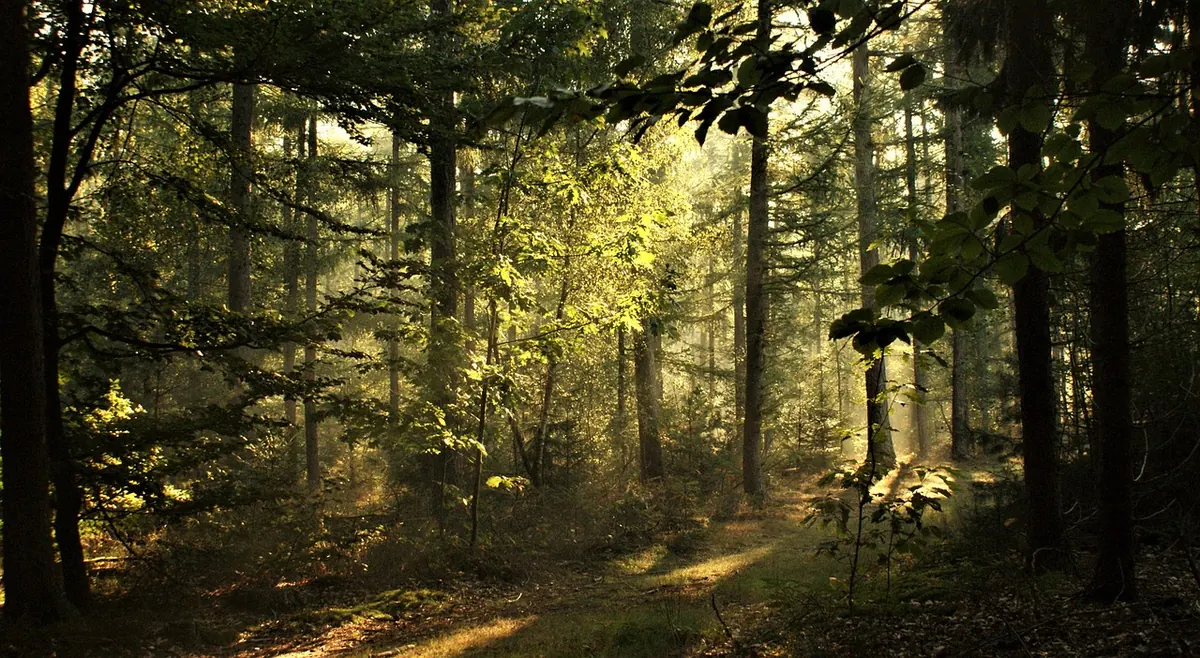


The animal is gone in four seconds. A shape between the trunks, a flash of white at the tail, a wingbeat close enough to feel. By the evening you remember that something happened, and by the following week you remember almost nothing else. Was it a roe deer or a fallow? Was it raining? Which path were you on?
This is the ordinary fate of most sightings, and it has nothing to do with a bad memory. It is simply that we tend to record the fact of the animal and skip everything around it — the conditions, the distance, the small behaviours that make a sighting into a record. The gap between a note that reads “saw a deer in the woods” and one you can still learn from two years later is rarely talent. It is a short list of things you remember to write down, in the same order, every time you stop and watch.
What follows is that list. Five points, no equipment required beyond a pencil, and a habit of writing them before you walk on.
The Checklist at a Glance
Keep the order fixed. A familiar sequence is faster in the field and easier to read later, because your eye learns where to look on the page. Five lines, then whatever else you want to say.
- Date and time — the day, the hour, and how long you watched.
- Weather and light — temperature, wind, cloud, rain, sun direction, visibility.
- Behaviour — what the animal was doing, in the order it did it.
- Distance and position — how far away, how you estimated it, where you stood.
- Habitat — the layers of the place: ground, eye level, canopy, and the edges nearby.
The rest of this piece takes each one in turn, with the kind of detail that is actually worth the ink.
1. Date and Time: The Anchor Everything Hangs From
Write the date first, before you write anything else, even if it feels obvious. Then the time you began watching — not the time you finished writing. If you watched for twelve minutes, say so; duration changes how much behaviour you were able to see, and future-you will want to know whether a short glimpse or a long observation produced the note.
Add two small things that are easy to forget and hard to reconstruct. First, the season phase rather than just the month: “third week of October, first hard frost two nights ago” tells you far more than “autumn”. Second, the place in a way that lets you return to it — a name, a junction of paths, a bend in the stream, a particular oak on a bank.
A word on times of day
Approximate times are fine as long as you mark them as approximate. “About forty minutes before sunset” is honest and useful. So is “just after the sun cleared the ridge”. Precision you do not have is worse than a rough figure you have labelled clearly.
2. Weather and Light: The Conditions That Brought It Out
Weather is the point most often reduced to a single lazy word. Skip “nice” and “mild”. Write what you can actually feel and see: temperature and whether it was rising or falling, wind direction and strength, cloud cover, whether it was raining or had recently rained, whether the ground was wet, frozen, or dry underfoot. Snow is worth a special note, since it holds tracks and tells you who else was out.
Then the light. Was the sun behind you, in front of you, or gone? Were you watching a sunlit edge while everything else stayed in shade? This matters more than it seems. A bird that looks grey in flat light can look strikingly pale with the sun on it, and the note you write from the memory of that colour will be wrong.
The reward for this line comes later, when you read back through a season. Patterns appear that you would never have noticed day to day: the same lawn visited by thrushes after rain, the same hedge line busy on windy days because the lee side stays calm.
3. Behaviour: What the Animal Was Actually Doing
This is the most valuable field and the one most often skipped. “Saw a fox” is a stamp in a passport. “Fox crossed the track at a walk, stopped, sniffed the base of a post for perhaps five seconds, then continued north without hurrying” is a record you can compare with the next one.
Use plain verbs and keep them concrete: foraging, preening, loafing, scent-marking, carrying food, stalking, alarm calling, scratching, drinking, chasing. Write the sequence — what it did first, what it did next, how it left. Note whether it noticed you, and at what point.
Describe, then interpret
Sound is part of behaviour, and it is worth trying to render it in words even when you are unsure: “a sharp chak-chak, repeated three times” is more useful than “called”. If an animal was watching something, say what you think it was watching, and mark it as a guess.
Keep observation and interpretation on separate lines. “Stamped a front foot, then stood tall” is observation. “Was warning the others” is a story. Both can go in the notebook — but only one belongs in the record.
4. Distance and Position: Rough Numbers, Honestly Labelled
You will almost never know the exact distance, and you do not need to. What you need is a figure you can defend. Pace it out after the animal has gone, or use something fixed: the length of a fence line, the width of a track, the distance between two birches. Then write “roughly 25 metres, estimated” and move on.
Record your own position with the same care:
- Were you downwind, upwind, or crosswind?
- Were you in the open, in cover, in a hide, on a raised path?
- Were you walking, standing still, or sitting?
- Were you using binoculars (and of what power), a camera, or the naked eye?
Then place the animal relative to a feature, not just “in the trees”: on the east side of the oak, on the bank above the stream, halfway up the slope below the ridge. That single clause often decides whether a record is checkable or useless.
5. Habitat: The Setting That Made It Possible
“Forest” is a category, not a habitat. The useful version describes layers. What was underfoot — leaf litter, moss, bracken, wet clay, grazed grass? What was at eye level — saplings, bramble, low branches, nothing at all? What was overhead — closed canopy, broken cover, open sky? Add the age and condition of the trees, the presence of deadwood, and the distance to water.
Edges deserve their own sentence. The boundary between woodland and field, the strip beside a stream, the line where the mown path gives way to nettles — these transitions attract animals, and noting them helps you predict where the next sighting will happen.
And record sign as well as animals. Tracks in mud, droppings, browsed shoots at a consistent height, a scatter of feathers, an owl pellet on a stump. Sign is wildlife observation too, and it fills the days when nothing shows itself.
A Two-Minute Routine That Makes It Stick
None of this takes long if you write it in the same order every time. Carry one small notebook and a pencil that works in the wet. Stop as soon as the animal has gone, while the picture is still sharp, and write the five lines before you walk on — even badly, even in shorthand. If your hands are cold or the light is going, speak the details into a voice memo and transcribe them the same evening, never later.
- Fill in all five points, even when the answer is “did not notice”. A blank is information.
- Mark estimates as estimates: “about”, “roughly”, “maybe”.
- Note what you did not see as well as what you did — no young, no second bird.
- Add one free line at the end: the thing that surprised you. That line is usually why you will read the entry again.
Do this for a season and something quiet happens. The entries stop being a list of animals and start being a record of a place — of what appears there, when, and under which conditions. The five points take two minutes. They are what make the sighting yours to keep.
Photo: Pexels / Pixabay
Related posts
More stories you’ll love reading